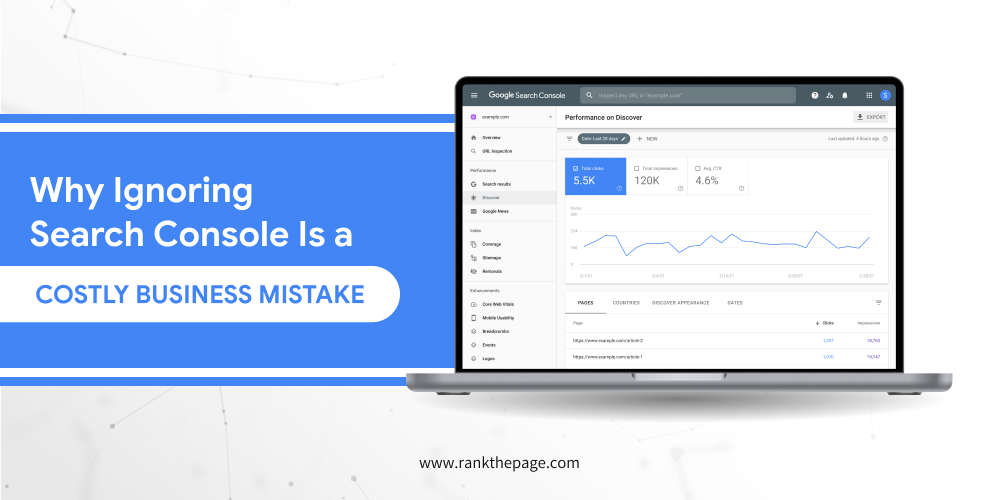
Search Console Is Your “Truth Serum” and it is the closest thing you have to Google’s own opinion of your website. It shows:
- What people are actually searching when your site appears.
- How often they see you (impressions) versus choose you (clicks).
- What technical or indexing issues are blocking your growth.
- How Google’s evolving features (like AI answers) are silently shifting your visibility.
Most businesses either set it up once and forget it, or never log in at all. The result? They make content, design, and budget decisions with no direct input from the one platform they depend on for search traffic.
1. Missed Demand: You’re Blind to What People Actually Want
When you ignore Search Console, you ignore real-world demand signals. That’s costly.
You Don’t See “Near-Win” Keywords
GSC shows queries where:
- You have high impressions but low clicks.
- You rank on page 1 or 2, but no one is choosing you.
- People clearly want something—but your content or angle doesn’t convince them.
These are your “near-win” keywords. With a small tweak—better title, clearer meta description, a dedicated landing page—you can convert impressions into revenue-driving clicks. Without GSC, you never even know these gaps exist.
Example scenario you can use in the blog:
- A local agency keeps publishing “SEO services” content.
- GSC reveals growing impressions for “SEO consultant near [city]” and “SEO audit price”.
- They had no dedicated pages or offers around these terms.
- That’s missed demand: people are literally asking for what you sell, but your site never steps up clearly enough to win the click.
You Miss Content Ideas That Come Straight From Google
Instead of guessing “What should we write next?”, GSC hands you:
- Exact phrases customers use (including long-tail questions).
- Countries, devices, and pages where demand is rising.
- Seasonal or trend-based queries you’d never guess in a brainstorming session.
When you ignore this, you default to intuition, competitor copying, or generic blog topics that may not map to real search behaviour. In other words, you’re producing content for yourself, not for demand.
2. Missed Trust Signals: You Ignore Google’s Feedback Loop
Search Console is also your trust report card.
If you never look at it, you miss the signals that tell you whether Google trusts your site enough to rank and recommend it.
You Don’t Notice When Google Stops Seeing Parts of Your Site
Inside Search Console, you’ll regularly find:
- Indexing issues (pages discovered but not indexed).
- Soft 404s (pages that look broken or thin to Google).
- Canonical problems (Google choosing different URLs than you intended).
- Mobile usability or Core Web Vitals warnings.
If you don’t check these:
- You might keep investing in pages Google is quietly ignoring.
- Important pages—like product or service pages—may be partially or completely invisible.
- Fixable technical issues slowly erode your authority over time.
This is not just technical debt; it’s lost trust. Search engines cannot reliably send traffic to a site that looks broken, inconsistent, or low quality from the crawl/index perspective.
You Waste Your Backlinks and Authority
Search Console also shows some of your backlinks and how Google interprets your site as a whole. If you never review:
- You may have strong links pointing to URLs that redirect or 404.
- Your internal linking may not support your most important pages.
- High-value pages might be buried, orphaned, or mis-categorized.
You’re essentially getting “votes of confidence” from the internet and then telling Google, “Do whatever you want with them; I’m not watching.” Over time, this slows growth and lets more diligent competitors overtake you.
3. Missed AI Visibility: You Don’t Know How You Show Up in AI Answers
This is the newest, and arguably the most overlooked, cost.
Search is no longer just “10 blue links.” AI answers, overviews, and summaries increasingly sit above traditional results. Brands can be:
- Cited in AI-generated responses.
- Used as a source without necessarily getting the click.
- Present in the experience even when analytics don’t show big traffic spikes.
The Problem: Traditional Metrics Don’t Tell the Full Story
Search Console impressions can include exposure through these new experiences, but:
- You don’t see a simple “AI Overview visibility” toggle.
- You can see impressions rising while clicks stagnate.
- You may be appearing in AI-style boxes without clear attribution in your usual dashboards.
If you never study how your queries, positions, and CTR trends are shifting, you’ll miss early warning signs that:
- AI is answering queries you target with zero-click results.
- You need to alter your content format to be more “citable” (clear definitions, concise answers, structured content).
- Your brand is gaining or losing “silent exposure” in these AI-powered zones.
Why This Matters for Authority
Being included as a cited source in AI answers is a form of reputation and expertise signalling, even when clicks don’t surge. Over time, brands that learn how to:
- Write clear, context-rich answers.
- Structure content with headings, FAQs, and definitions.
- Address user intent in a concise, query-aligned way,
will appear more often as the “trusted explanation” in AI experiences.
If you ignore Search Console, you won’t even see the indirect signs—query behaviour changes, impressions-to-clicks ratios, new countries or devices spiking—that hint your niche is being reshaped by AI answers.
4. “Rank The Page” Approach: Understanding Google Without Jargon
Let’s translate all of this into a simple, the below style mental model you can drop straight into your blog.
Think of Search Console as three dashboards:
- Demand Dashboard (Performance tab)
- Impressions = “People saw you.”
- Clicks = “People chose you.”
- CTR = “How convincing you were.”
- Position = “How visible you are.”
- Ask weekly:
- Which queries see me a lot but click me rarely?
- Which pages get visibility but don’t convert?
- What new topics are emerging in impressions?
- Trust Dashboard (Pages, Coverage, Experience)
- Indexing = “Google can find and store you.”
- Experience = “Google thinks users will have a decent time on your site.”
- Enhancements = “You’re using modern features (schema, rich results, etc.).”
- Ask monthly:
- Are any critical pages not indexed?
- Are we getting mobile or performance warnings?
- Are we eligible for rich results where it matters?
- AI Era Dashboard (Trends & Patterns)
- Watch how impressions, clicks, and CTR evolve for informational queries.
- Look for rising impressions but flat clicks—this often hints at zero-click or AI-answered queries.
- Use this to decide:
- Where to double down with better, more citable content.
- Where to accept that visibility is now brand-building, not traffic-heavy.
If you want to turn Google’s signals into a structured growth system, connect with us and let’s build authority the right way.
About author

rankthepage
At Rank The Page, we’re committed to providing the right digital support and guidance needed for your business to thrive. We’re a team of enthusiast digital marketers and other professionals working together to drive more traffic to your website and solidify your brand reputation.