The Vanity Metric Trap Inside GA4
There’s a quiet trap inside GA4.
It’s called pageviews.
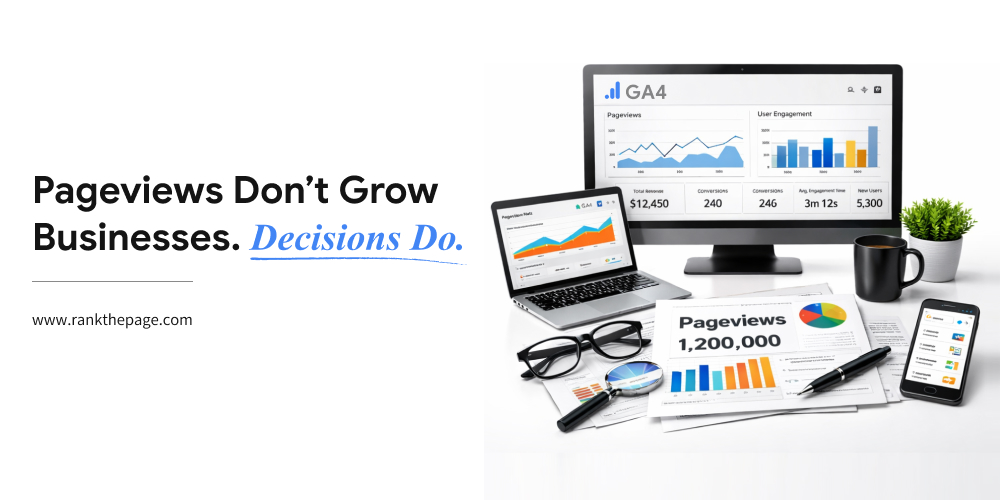
They look impressive in reports. They create movement in dashboards. They give teams something to celebrate. But pageviews don’t increase revenue. They don’t improve margins. And they don’t build durable growth.
Decisions do.
If you’re a founder or CEO, your relationship with analytics must be different from your marketing team’s relationship with analytics. Your job isn’t to monitor activity. Your job is to allocate capital, prioritize initiatives, and remove bottlenecks.
That requires a different lens.
Attention vs. Outcomes
Most businesses log into GA4 and immediately look at traffic spikes. “We had 40% more pageviews this week.” That sounds positive. But the real question is: did anything materially improve?
More visibility without stronger conversion is simply more noise.
Pageviews are attention metrics. They tell you someone looked. They don’t tell you someone acted.
A business scales when attention turns into measurable progress — purchases, booked calls, qualified leads, subscriptions.
The CEO view of analytics focuses on outcomes, not activity.
A CEO doesn’t ask, “How many people visited?”
A CEO asks, “Which channel produces the highest-quality customer?”
Reading GA4 Through a Revenue Lens
To read GA4 like a CEO, you must examine revenue-linked behavior.
Which traffic sources generate actual conversions?
Is paid acquisition improving cost efficiency — or just increasing exposure?
Are returning users converting at higher rates than new visitors?
These are leverage questions.
If organic search drives fewer users but higher-quality leads, that insight should shape long-term strategy. If paid ads generate traffic without profitability, scaling them may amplify inefficiency.
CEOs allocate resources based on performance, not popularity.
Pageviews are popular.
Profitability is powerful.
Customer Journeys Reveal Strategic Weakness
GA4 does more than track visits. It maps behavior.
If thousands of visitors reach your pricing page but few move forward, that’s not just a marketing issue. It could signal positioning gaps, unclear value, friction in the buying process, or trust concerns.
Instead of celebrating high traffic on product pages, ask:
Are visitors progressing?
Are they hesitating at a specific step?
Are they abandoning checkout?
Every drop-off is not just a number. It is operational intelligence.
Businesses that scale don’t ignore friction. They eliminate it.
The CEO Framework for Reading GA4
When reviewing analytics, filter every metric through three questions:
Is this tied to revenue?
Does it impact acquisition cost?
Does it expose friction in the journey?
If the answer is no, it’s likely not a strategic priority.
This doesn’t make pageviews useless. They are early indicators of awareness. But awareness alone does not build sustainable businesses.
A retail store filled with visitors who never purchase does not celebrate foot traffic.
It fixes its offer.
Growth Comes From Decisions, Not Dashboards
Founders who build enduring companies treat analytics as a decision engine, not a reporting ritual. They use data to double down on what works, remove waste, and refine positioning.
Because businesses don’t scale from dashboards.
They scale from decisions informed by the right signals.
At RankThePage, we help founders move beyond vanity metrics and interpret Google data with strategic clarity. When analytics are aligned with business outcomes, they stop being numbers on a screen and start becoming competitive advantage.
Pageviews show movement.
Decisions drive growth.
We Respect your Time.
About author

rankthepage
At Rank The Page, we’re committed to providing the right digital support and guidance needed for your business to thrive. We’re a team of enthusiast digital marketers and other professionals working together to drive more traffic to your website and solidify your brand reputation.