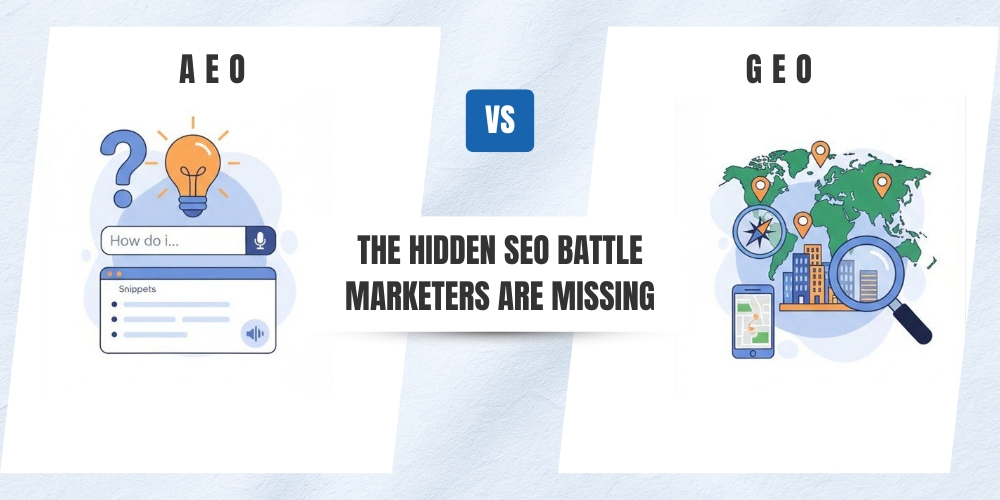
Search is changing faster than anyone expected. Only a few years ago, businesses competed to appear on the first page of Google. Getting into the top three results meant high traffic, better visibility, and more customers. But today, even ranking #1 on Google does not guarantee clicks. AI is rewriting the rules of search in real-time. It answers questions instantly, summarizes long content within seconds, and chooses which sources to trust without needing users to visit multiple sites.
Many marketers still haven’t realized this shift. They continue using the same old SEO strategies, hoping that keywords, backlinks, and on-page optimization will bring traffic. But what they don’t see is the silent battle happening in the background, a battle between AEO and GEO. These two forces are shaping the future of search, and businesses that fail to understand them risk losing their digital presence slowly and silently.
This blog will enable you to see the whole picture with simple language. You will find out the true meaning of AEO and GEO, their importance, their difference from the old-fashioned SEO, and which approach your business will take in 2026.
Understanding AEO: Why Answer Engines Are Taking Over Search
AEO stands for Answer Engine Optimization, and as the name suggests, it focuses on optimizing content for platforms that give direct answers rather than showing long lists of links. Google’s new AI Overview, voice assistants, chat-based search engines, and smart devices all use answers, not results. Instead of showing users ten blue links, they show a clear response that directly solves the query.
This shift exists because users want instant clarity. They don’t want to scan multiple websites or scroll endlessly. They prefer simple, direct, quick answers, something that solves their problem in one go. AEO helps your content match this new behavior by presenting information in a way that AI systems easily understand and prioritize.
AEO in Real World: Why Businesses Must Pay Attention
Most people don’t know this, but AI overview panels and voice assistants often choose one main source to highlight. If your content fits the answer format, your brand can appear before all your competitors, even those who may rank higher in traditional search.
Businesses that rely on educational content, local search questions, or quick summaries benefit the most from AEO. For example, clinics, service providers, consulting agencies, tech businesses, eCommerce websites, and blogs all have users who frequently ask direct questions.
AEO helps you position your website to become the most suitable answer for such queries, meaning your business can gain visibility without even being clicked on traditionally—especially when it’s supported by a complete strategy that combines AEO, GEO, and SEO, as explained in our guide on AEO vs GEO vs SEO: The Clear SEO Blueprint for Your Business:
Understanding GEO: The New Backbone of AI Search
GEO stands for Generative Engine Optimization, and this is where the future becomes even more interesting. While AEO focuses on appearing as the answer, GEO focuses on becoming a trusted source that generative AI systems use when creating content.
In contrast to the old search engine, AI-based applications such as ChatGPT, Gemini, and Perplexity do not merely display the results but generate them by processing various resources.
That is to say that what you write today may influence what AI is saying tomorrow.
GEO makes sure that your content is organized, full of information, and delivered in a manner that can be used by generative systems with confidence. When AI engines trust your site, they will refer to it, reference it, promote your brand, and use your material to answer questions of people. This is not limited to Google but to every type of AI tool used by users.
Why GEO Matters More Than Marketers Realize
Many business owners, even experienced ones, still think SEO alone is enough. But generative AI is quickly becoming a major source of information for millions of users. Students search on ChatGPT instead of Google. Professionals use Perplexity instead of reading multiple articles. Consumers rely on AI summaries before buying products or choosing services.
If AI tools pull answers from your competitors instead of you, your brand becomes invisible, not because your content is bad, but because it wasn’t optimized for AI systems.
GEO solves this problem by making your content AI-friendly. It helps AI engines recognize your brand as a trustworthy authority, which leads to more mentions and better visibility across multiple platforms.
Do You Know? (Fact #1)
Recent studies show that 42% of search sessions no longer include a website click because AI tools and answer engines provide instant responses.
This means businesses relying only on old SEO strategies may lose almost half their potential traffic.
AEO vs GEO: Understanding the Core Difference
Even though both concepts support AI-driven search, they work differently. AEO focuses on direct answers. GEO focuses on deep content recognition by AI systems.
Think of it like this:
- AEO works like a spokesperson, it gives short, clear answers.
- GEO works like a researcher; it helps AI systems analyze your content and trust it.
Both are important, but their roles differ greatly.
AEO is ideal for quick queries, FAQs, and simple explanations, while GEO is better suited for detailed topics, industry insights, and expert-level content. Together, they create a powerful strategy that supports both fast answers and deep AI understanding—a distinction we’ve explored further in our detailed breakdown of AEO vs GEO and which strategy is likely to rule search engines in 2026.
How These Shifts Impact Businesses Today
Businesses that adapt to AEO and GEO early have a huge advantage. They appear in voice searches, AI summaries, chatbot recommendations, and new generative platforms before others even notice. Their content is used more often, trusted more often, and displayed more often.
Meanwhile, businesses that continue using only traditional SEO without AEO or GEO find themselves struggling with declining clicks, lower visibility, and reduced search presence, even if their SEO is technically strong.
This is the hidden battle marketers are missing. The competition has already shifted from ranking to becoming a reliable answer source. And the businesses that respond quickly will lead their industries.
Why Your Business Needs All Three: AEO, GEO, and SEO
Most companies ask which one they should choose. The answer is simple: every business needs all three. SEO brings long-term traffic and rankings. AEO brings quick-answer visibility. GEO brings AI-powered recommendations and future-proof presence.
Without SEO, your website can’t grow organically.
Without AEO, your content may miss zero-click visibility.
Without GEO, AI tools will ignore your brand.
Businesses that combine these strategies see faster, smarter, and more stable results because they cover every part of the modern search landscape.
Conclusion:
AI and Google search are now the new basis of online visibility. This isn’t just a trend, it’s the future. AI search engines are changing how people find information, and this change will only grow. Businesses that focus on giving clear answers, creating AI-friendly content, and using strong SEO will stay ahead of their competitors in the coming years.
If you want your brand to grow and beat your competitors, Rank The Page can help. We create a full AEO, GEO, and custom SEO plan that matches your business goals and helps you build a stronger online presence.
FAQs


Ans.Yes. Both are essential for AI-driven search visibility, and each supports a different part of user intent.
Ans.No. SEO will always remain the foundation. AEO and GEO add more strength to it.
Ans.In many cases, AEO improves quick-answer visibility within a few weeks.
Ans.Because AI models rely on trusted sources, GEO makes sure your content becomes one of them.
Ans. Yes. AI engines are already replacing many traditional search clicks.
About author

rankthepage
At Rank The Page, we’re committed to providing the right digital support and guidance needed for your business to thrive. We’re a team of enthusiast digital marketers and other professionals working together to drive more traffic to your website and solidify your brand reputation.