The underlying infrastructure of the internet is experiencing an architectural evolution. We are transitioning from traditional search engine indexing to large language model (LLM) contextual grounding. Google formalized this shift by releasing a dedicated standalone module: the Search Generative AI Performance Reports inside Google Search Console (GSC).
For brands evaluating their digital footprint, this update offers a raw, unfiltered lens into how Google’s AI systems process, store, and display their proprietary information. As a forward-thinking digital marketing company in India, we have spent months analyzing early data from this rollout. This technical guide explores the native features, system benefits, and real-world diagnostics required to manage your site’s generative footprint.
The Core Features: Understanding What Data Google Tracks Now
The new dashboard does not simply append data to your existing organic reports. Instead, it segments your properties into an entirely isolated parsing framework. It breaks down visibility across distinct, specialized generative channels:
Core Reporting Streams
- Generative AI (Search): Captures whenever your assets are utilized to anchor conversational snapshots inside AI Overviews or the highly conversational, multi-turn AI Mode (Chat).
- Generative AI (Discover): Tracks programmatic content selection within personalized interest cards driven by underlying generative recommendations.
Available System Data Dimensions
Google isolates data into five granular structural dimensions to help you verify exactly how machine-learning bots ingest your pages:
- Impressions: The total frequency with which your site’s URLs serve as source citations or context cards inside an active AI interface.
- Pages: Precise URLs used by the machine-learning engine to validate and ground its real-time outputs.
- Countries: Regional intelligence that shows which regional edge databases are utilizing your data assets.
- Devices: Hardware profiles separating desktop, mobile, and tablet requests.
- Dates: Time-series logging with hourly granularity (tracked via Pacific Time), allowing engineering teams to map performance drops or algorithm revisions down to the hour.
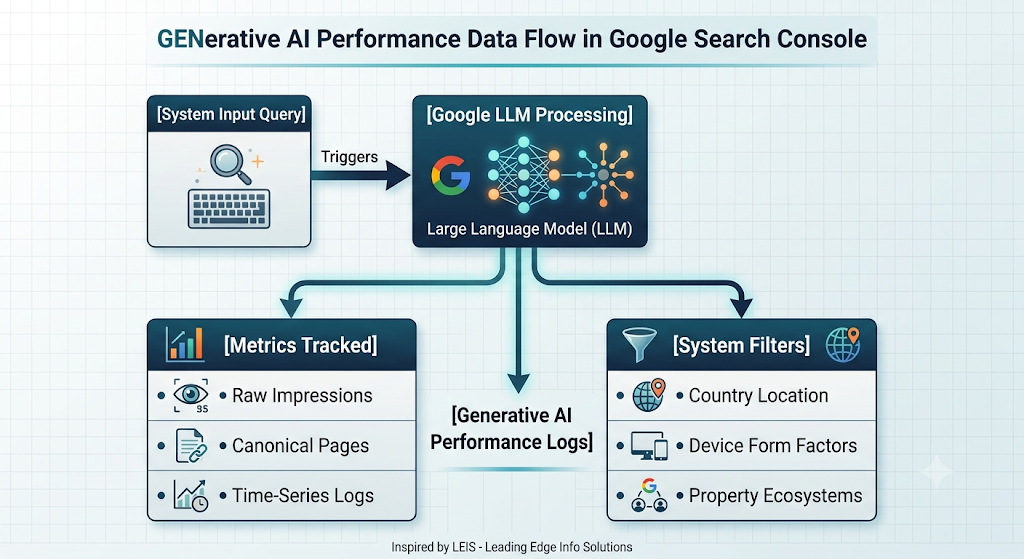
When analyzing these dimensions, hiring an experienced local seo company can help you unpack how regional trends affect your visibility. For instance, Google automatically channels all generated AI impressions to the canonical URL structure. This eliminates parameter noise, tracking errors, or session-ID bloat in your reporting data.
How AI Tracking Reports Compare to Traditional SEO Reports
Understanding what this report fundamentally fixes requires looking at how search data was blended previously. The structural transition provides deep data separation:
| Measurement Metric | Traditional SEO Reports | New AI Tracking Reports |
| Data Isolation | Generative AI impressions were completely bundled into standard Web Organic Search metrics, masking AI-specific attribution. | Generative AI features receive a dedicated, distinct interface pipeline completely separated from standard search clicks. |
| Verification of Sources | Brands had to rely on expensive, volatile third-party SERP scrapers to check if they were cited in AI Overviews. | Google provides an official, clean database log mapping exactly which URLs served as historical grounding nodes. |
| System Ecosystem Tracking | Tracking was constrained to standard Web, Image, Video, and News tabs. | Comprehensive visualization across different interfaces like AI Overviews, AI Mode, and Discover AI features. |
| Algorithmic Controls | Webmasters had to rely on blunt instruments like the Google-Extended token, which risks blocking model training entirely. | A specialized GSC toggle switch allows publishers to exclude content from real-time live search grounding without hurting traditional rankings. |
Benefits: The Analytical Value to Modern Enterprises
This update solves a massive data visibility gap for enterprise brands, data engineers, and webmasters alike.
Decoding “Zero-Click Search” Attribution
A common challenge handled by any SEO company is explaining drops in standard click-through volume even when keyword rankings remain steady. This new dashboard clarifies that reality. If traditional informational web page views drop but your Generative AI metrics show strong growth, your content isn’t losing authority. It simply means your data is being served directly inside the user interface. This insight allows you to re-adjust internal user funnels appropriately.
Real-Time Validation of Domain Trust
When Google’s core system pulls your link into an AI Overview block, it serves as an algorithmic confirmation of domain authority. The report acts as proof that your content holds high semantic depth, is structurally clear, and fulfills E-E-A-T requirements cleanly enough to ground live, user-facing automated answers.
Freedom From Third-Party Guesswork
Most third-party software attempts to calculate AI Overview tracking through localized browser emulation, which often skips personalized user results. This GSC update delivers clean, direct data straight from Google’s infrastructure, ensuring accuracy across global corporate reporting.
Step-by-Step Guide: How to Use This Data to Audit and Improve Your Content
Simply looking at a new graph won’t move your bottom line. To convert these insights into growth, your technical team must establish a clean analysis workflow or prefer hiring the best digital marketing company in India:
Step 1: Document Your Baseline
Export your initial 30 days of performance data to build a clean baseline. Identify your top-performing AI Magnets – the specific URLs producing the bulk of your impressions. Study their presentation format (e.g., are they answering definitions, displaying pricing data tables, or detailing technical procedures?).
Step 2: Conduct an Organic-to-AI Gap Audit
Cross-reference your top traditional ranking landing pages against the new report. Look for valuable high-intent pages that hold top-tier conventional rankings but show exactly zero generative AI impressions. This gap usually reveals an underlying structure issue, semantic ambiguity, or code block that prevents the automated crawler from properly parsing your information.
Step 3: Run Targeted On-page SEO Services
Once you identify your high-ranking but AI-invisible pages, execute an optimization pass. This is where advanced on-page SEO Services become critical to your strategy. Focus on technical data clarity:
- Implement precise, clean bullet points for process steps.
- Organize complex data strings using clean HTML tables.
- Use strict, nested header hierarchies (H2, H3) to clear up entity relationships.
- Deploy advanced schema markup to ensure the crawler can effortlessly map the relationships between your products, services, and locations.
Step 4: Map Out a Multi-Channel Balance
Because AI interfaces continuously change, relying entirely on one traffic channel is a risk. Therefore, utilizing a white label SEO agency to scale your business offerings, or running balanced paid ad campaigns alongside organic efforts, a diversified search strategy ensures your lead pipeline remains protected.
Implement Growth Strategy with India’s Leading Digital Marketing Experts
The search landscape is moving quickly, but these changes present a massive opportunity for brands that act early. At RankThePage, we are the best seo agency in India, combining technical mastery, deep data diagnostics, and data-driven execution to ensure your digital assets lead the industry.
Contact our expert team today for a comprehensive domain evaluation, and let’s ensure your business owns the future of search.
Frequently Asked Questions


Ans.There are two potential reasons for a missing menu item.
- First, Google is expanding access incrementally, starting with test markets like the United Kingdom before opening up to international users.
- Second, your site must cross an internal data threshold of live AI impressions. If your content has not yet been selected by Google’s LLM to ground search responses, the dashboard remains hidden until your site registers enough baseline visibility.
Ans.Our local SEO experts recommend keeping your business name, address, and phone number (NAP) consistent across your website, social profiles, and local directories. Adding geo-targeted schema markup also helps AI search engines better understand your business and local service areas.
Ans.While Google Search Central confirms that click data will be added down the line, you can track performance right now using custom web analytics segmentation:
- Track Direct Brand Lift: Monitor direct branded search queries within standard GSC reports, as users often search for brands they saw named in an AI citation.
- Isolate Traffic Spikes: Monitor organic traffic to your top-performing “AI Magnet” pages using Google Analytics, watching for direct conversion changes that align with your AI impression spikes.
Ans.Yes, this dataset is a valuable asset for white label SEO agencies. It provides verified, first-party reports that show how client content appears in Google’s AI-powered search, helping demonstrate measurable SEO value beyond traditional rankings.
About author

rankthepage
At Rank The Page, we’re committed to providing the right digital support and guidance needed for your business to thrive. We’re a team of enthusiast digital marketers and other professionals working together to drive more traffic to your website and solidify your brand reputation.