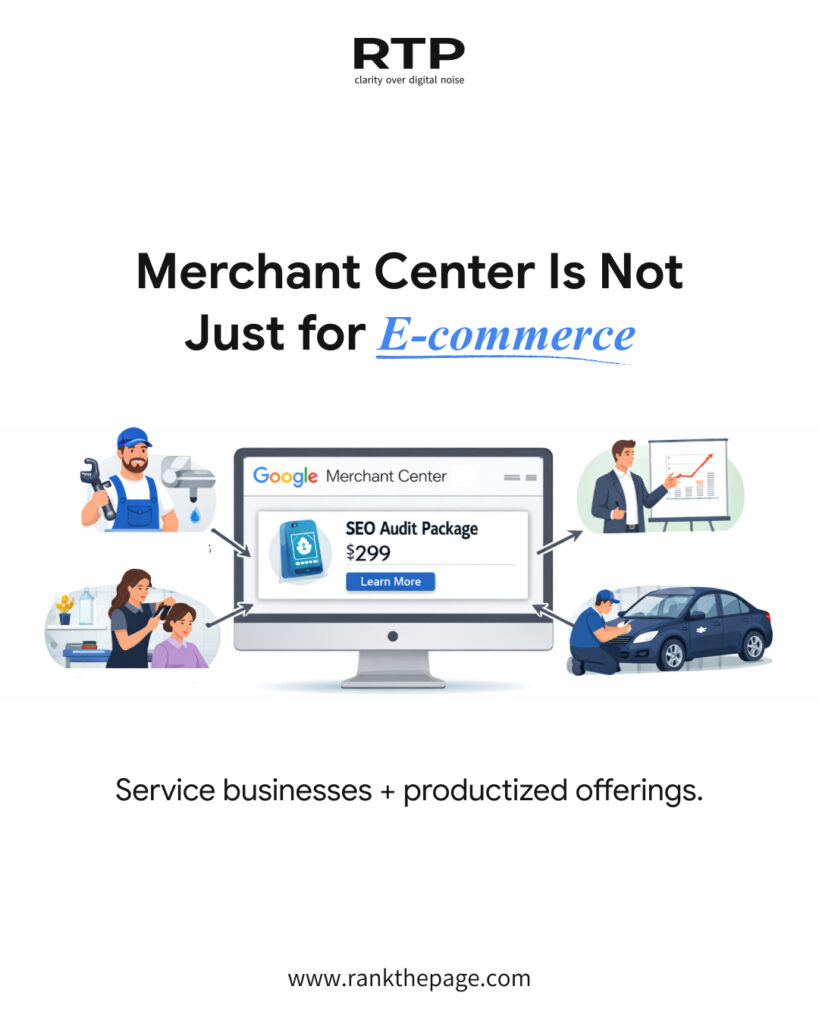
A Founder’s Guide to Turning Services into Discoverable Offerings
Introduction: The Misunderstood Growth Lever
For years, Google Merchant Center has been boxed into a very narrow definition—a tool meant only for e-commerce businesses. Founders who sell physical products have traditionally used it to upload inventories, run shopping ads, and gain visibility in Google Shopping results. Meanwhile, service-based founders, consultants, agencies, and digital product creators have largely ignored it, assuming it has nothing to do with their business model.
But this assumption is no longer valid.
Google itself has evolved. It is no longer just a search engine that lists websites—it is now a decision engine that helps users compare options, evaluate pricing, and make choices directly within its ecosystem. This transformation has fundamentally changed how visibility works. It is no longer enough to simply “have a website” or “rank on Google.” What matters now is how clearly and structurally your offerings are understood by Google.
This is where Merchant Center becomes relevant for every founder, not just e-commerce brands.
At its core, Merchant Center is not about physical products—it is about structured data. It allows businesses to define what they offer in a way that Google can easily process, categorize, and display across multiple discovery surfaces such as Search, Shopping, and Images. And in today’s environment, anything that can be clearly defined, priced, and delivered—whether it is a product, a service, or a digital experience—can be structured and surfaced.
This creates a massive opportunity for founders who are willing to rethink how they present their business.
If you run a service-based company, sell digital products, or operate a hybrid model, you are already offering value that can be structured. The only difference is that most founders present it in a way that is optimized for humans but not for Google’s systems. Merchant Center bridges that gap.
This article will break down:
- Why most founders are invisible in high-intent search moments
- The core problem with how services are currently positioned
- How Merchant Center can be used as a solution—even without e-commerce
- And how to rethink your business as a catalog of offerings
The Problem: Why Service Businesses Struggle with Visibility
Despite having strong expertise, great results, and valuable offerings, many service-based businesses struggle to achieve consistent visibility on Google. The issue is rarely about quality—it is about structure and clarity.
1. Vague Positioning Limits Discoverability
Most founders describe their services in broad, generic terms:
- “We offer digital marketing”
- “We provide consulting services”
- “We help businesses grow online”
While these statements may sound professional, they are not aligned with how users search or how Google interprets intent.
When a user searches on Google, they are rarely looking for vague solutions. Instead, they search with specific intent, such as:
- “SEO audit cost in India”
- “website design package pricing”
- “LinkedIn profile optimization service”
Google prioritizes results that match this specificity. If your business does not clearly define what it offers in structured terms—complete with pricing, scope, and deliverables—it becomes difficult for Google to position you in these high-intent searches.
2. Lack of Pricing Transparency Reduces Relevance
Another major issue is the absence of pricing.
Many founders intentionally avoid displaying prices on their websites, believing it encourages inquiries. While this may work in certain sales contexts, it creates a visibility problem in Google’s ecosystem.
Google increasingly favors listings that include:
- Clear pricing
- Comparable offerings
- Defined value
Without pricing, your offering becomes less competitive in search environments where users are actively comparing options. Merchant Center, in particular, is built around structured listings that include price data. If your offerings lack this clarity, they are less likely to surface in these environments.
3. Services Are Not Structured Like Products
Google’s systems are designed to process structured data efficiently. Products naturally fit into this structure because they have:
- Names
- Prices
- Descriptions
- Images
Services, on the other hand, are often presented as unstructured text on a webpage. This creates a disconnect. Even if your service is valuable, Google struggles to categorize and display it effectively.
For example, a page that describes “SEO services” in paragraphs is harder for Google to interpret compared to a structured listing like:
- SEO Audit – ₹5,000
- Monthly SEO Package – ₹25,000
The second format aligns with how Google organizes and ranks offerings.
4. Over-Reliance on Traditional SEO
Most founders rely heavily on traditional SEO strategies:
- Writing blog posts
- Optimizing keywords
- Building backlinks
While these methods are still important, they are no longer sufficient on their own.
Google’s ecosystem has expanded to include:
- Shopping results
- Visual discovery (Images)
- Rich product snippets
If your business is not present in these layers, you are missing a significant portion of potential visibility. Merchant Center acts as a gateway into these additional surfaces.
5. Missed High-Intent Opportunities
Perhaps the biggest problem is that service businesses often miss high-intent search moments.
These are the moments when users are closest to making a decision—when they are actively comparing options and looking for pricing, packages, and deliverables.
Without structured offerings, your business may still attract traffic through informational searches, but it struggles to convert that traffic into actual leads or sales. Merchant Center is specifically designed to position offerings in these decision-stage moments.
The Solution: Using Merchant Center Beyond E-commerce
The solution lies in a fundamental shift: treat your services like products.
Merchant Center enables this transformation by allowing you to structure your offerings in a way that aligns with Google’s ecosystem.
1. Productizing Your Services
The first step is to convert abstract services into productized offerings.
Instead of selling “expertise,” you define:
- What exactly you deliver
- How long it takes
- What it costs
For example:
- SEO Audit – ₹5,000
- Website Redesign Package – ₹30,000
- LinkedIn Profile Optimization – ₹3,000
This approach creates clarity for both users and Google.
2. Creating Structured Listings
Once your services are productized, you can create structured listings within Merchant Center that include:
- Title
- Description
- Price
- Image
- Landing page URL
These elements allow Google to categorize your offerings and display them in relevant search contexts.
3. Leveraging Structured Data for SEO
To maximize effectiveness, Merchant Center should be supported by structured data on your website.
Using schema markup such as:
- Product schema
- Offer schema
helps Google connect your website content with your Merchant Center listings. This improves consistency and increases the likelihood of appearing in rich results.
4. Aligning with Search Intent
Merchant Center works best when your offerings align with high-intent keywords.
Examples include:
- “SEO audit service India”
- “website design package pricing”
- “buy social media templates”
By structuring your offerings around these queries, you increase your chances of being discovered at the exact moment users are ready to take action.
5. Expanding Visibility Across Google
One of the biggest advantages of Merchant Center is its ability to expand your presence across multiple surfaces.
Your offerings can appear in:
- Search results
- Shopping listings
- Image-based discovery
This multi-channel visibility increases your reach and reduces dependence on a single traffic source.
Conclusion: The Future of Visibility Is Structured
The way businesses are discovered on Google is changing.
It is no longer enough to:
- Have a website
- Rank for keywords
- Publish content
The new competitive advantage lies in how clearly your offerings are structured and presented.
Merchant Center represents this shift. It is not just an e-commerce tool—it is a visibility engine for any business that can define its offerings with clarity.
For founders, the implication is clear:
- If you provide a service, you can structure it
- If you can structure it, you can list it
- If you can list it, you can be discovered in high-intent moments
This transforms your business from a vague service provider into a catalog of offerings that Google can understand and promote.
The founders who adapt to this shift will not just gain more visibility—they will gain better visibility. They will show up when it matters most, in front of users who are ready to decide.
And in today’s ecosystem, that is where real growth happens.
We value your Time
About author

rankthepage
At Rank The Page, we’re committed to providing the right digital support and guidance needed for your business to thrive. We’re a team of enthusiast digital marketers and other professionals working together to drive more traffic to your website and solidify your brand reputation.