There was a time when getting traffic from Google felt almost predictable. If you researched the right keywords, optimized your article, structured your headings, and built a few backlinks, you had a fair chance of ranking on the first page of search results. For years, SEO (Search Engine Optimization) revolved around this formula. Marketers focused on creating pages designed to match search queries, hoping that when someone typed a question into Google, their website would appear with the perfect answer. But the way people discover content online is quietly evolving, and with that evolution, Google’s algorithm is changing too.
Today, a large portion of content discovery happens even before a user searches for anything. When someone opens the Google app on their phone, they often see a stream of articles, news, and updates tailored to their interests. This personalized feed is known as Google Discover. Unlike traditional Google Search, Discover doesn’t wait for a question. It anticipates what a person might want to read based on their previous behavior — the topics they follow, the videos they watch, the websites they visit, and the content they engage with.
This shift may seem subtle, but it represents a major change in how visibility on Google works. Instead of simply ranking individual pages based on keywords, Google Discover recommends content from sources it considers reliable and relevant for a particular topic. Over time, it becomes clear that Google isn’t only evaluating the article itself. It is evaluating the source behind the article.
Imagine two different websites publishing an article about digital marketing trends. One is a blog that occasionally posts about marketing but also writes about travel, finance, and lifestyle topics. The other is a platform that consistently shares insights, strategies, and updates specifically about digital marketing. Even if both articles are well written, Google Discover is far more likely to recommend content from the second website. The reason is simple: the platform has built authority around that topic. It has demonstrated consistency, expertise, and credibility.
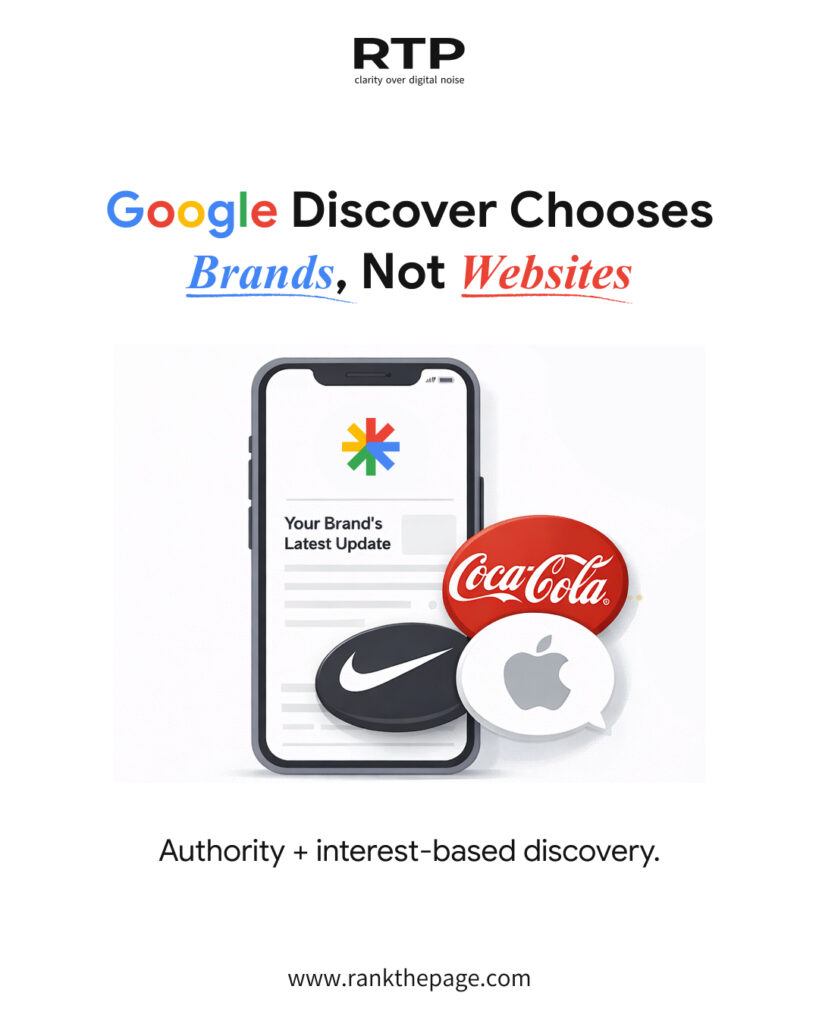
This is why many marketers have started saying that Google Discover chooses brands rather than websites. A brand, in this context, doesn’t necessarily mean a huge company or a famous name. Instead, it refers to a recognizable source of expertise that consistently publishes valuable content within a particular area. Over time, that consistency signals trust to both readers and search algorithms.
Think about how people consume information in everyday life. When you want to learn about technology, you might turn to well-known tech publications. When you want marketing advice, you might follow marketing experts or platforms that regularly share insights in that field. Rarely do people rely on completely random sources every time they search for information. Instead, they gravitate toward voices they trust.
Google Discover mirrors this behavior. It tries to recommend content from publishers that users have previously engaged with or from sources that demonstrate strong topical authority. If people regularly click on a particular website’s articles, spend time reading them, and return for more content, the algorithm begins to recognize that source as valuable. Over time, it becomes more confident recommending that publisher again.
User engagement plays a significant role in this process. When a piece of content appears in a Discover feed, user actions provide signals that help Google evaluate its quality. If readers click the article, stay on the page for a while, scroll through the content, or visit other articles from the same website, those behaviors indicate that the content was useful. On the other hand, if users quickly leave or ignore the content, the algorithm interprets that as a sign that the recommendation wasn’t relevant.
These signals gradually shape the reputation of a website within the Google Discover ecosystem. Consistently positive engagement metrics build trust, and trust leads to more visibility. Over time, a website that regularly publishes meaningful, well-received content begins to stand out. It becomes more than just another domain on the internet. It becomes a trusted brand within its niche.
This shift also changes how content strategies should be approached. In the past, many websites attempted to capture traffic by covering as many topics as possible. The logic was simple: the more keywords you target, the more opportunities you have to rank in search results. While this approach sometimes worked for traditional SEO strategies, it doesn’t necessarily translate well to Google Discover.
Google Discover tends to reward depth, expertise, and topical consistency rather than scattered content. Websites that repeatedly publish thoughtful content about a specific subject gradually build topical authority. When Google sees a clear pattern — a site consistently contributing valuable insights about one area — it becomes easier for the algorithm to understand what that publisher represents. That clarity increases the likelihood of their content being recommended to users interested in that topic.
Another interesting aspect of Google Discover is the importance of familiarity. When readers repeatedly see content from the same source and find it helpful, they become more inclined to engage with that publisher again. This behavior strengthens the relationship between the audience and the content creator. Over time, that relationship forms the foundation of what we recognize as a brand.
In many ways, the future of digital visibility is moving beyond simple keyword optimization. Technical SEO still matters, of course, but the larger focus is shifting toward building authority, credibility, and trust. Brands that consistently share valuable insights, thoughtful analysis, and useful information are gradually establishing themselves as reliable voices in their industries.
For marketers, content creators, and brands, this shift carries an important lesson. Success in platforms like Google Discover isn’t just about publishing content — it’s about building credibility over time. Every article contributes to a larger narrative about what a website represents. When that narrative becomes clear and consistent, both readers and search algorithms begin to recognize the source behind the content.
Ultimately, Google’s goal is to deliver the most helpful, relevant, and trustworthy information to users. In a world where the internet contains billions of web pages, identifying reliable sources becomes essential. Google Discover reflects Google’s effort to move closer to that goal by recommending content from publishers that demonstrate genuine expertise and authority.
The result is a subtle but powerful transformation in how online visibility is earned. Websites that focus only on producing isolated pieces of content may struggle to stand out. But those that consistently contribute meaningful ideas and build authority within a niche gradually earn recognition.
And when that recognition grows strong enough, the platform begins to treat them differently. Their articles don’t just appear because they match a keyword. They appear because the source behind them has become trusted.
In that sense, the statement becomes surprisingly accurate: in the world of Google Discover, the algorithm is not simply choosing websites.It is choosing brands.
We Respect your Time.
About author

rankthepage
At Rank The Page, we’re committed to providing the right digital support and guidance needed for your business to thrive. We’re a team of enthusiast digital marketers and other professionals working together to drive more traffic to your website and solidify your brand reputation.